
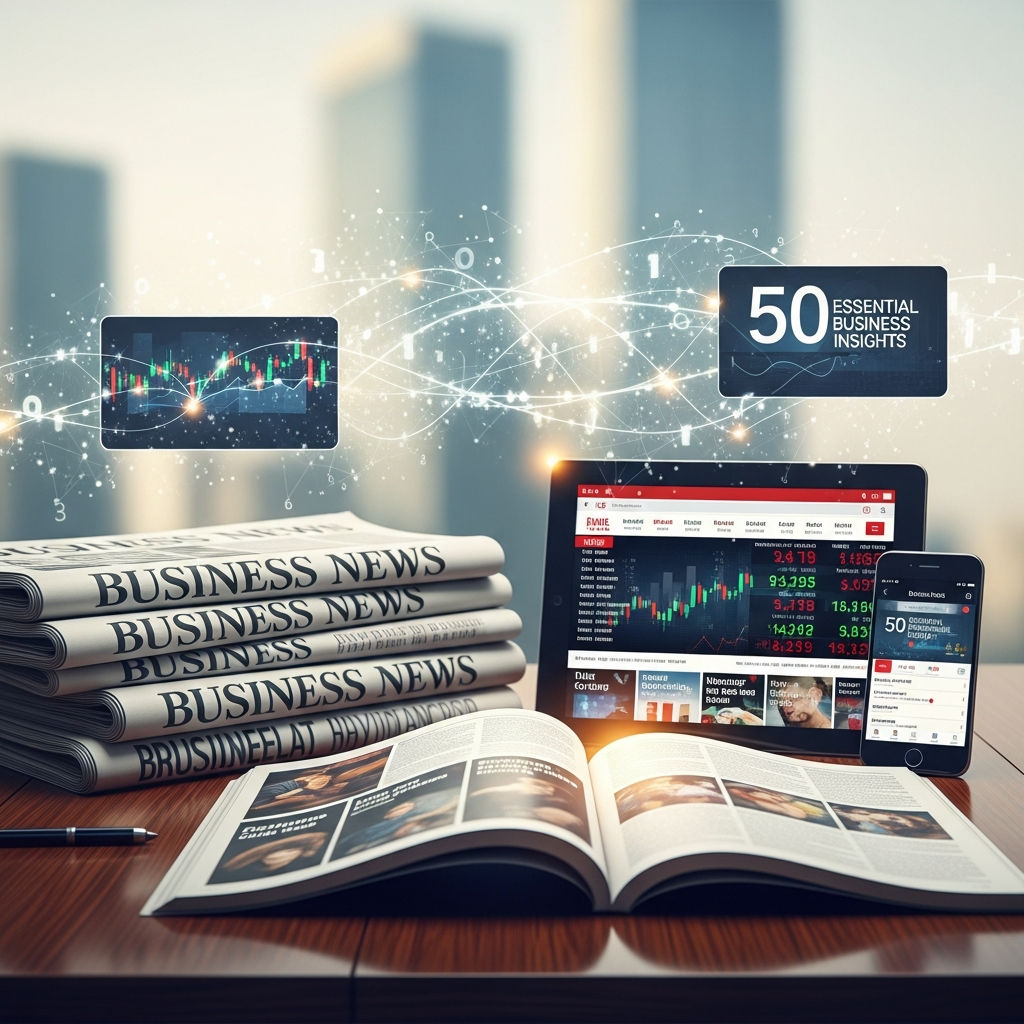
Is Business News Still Relevant? 50 Facts That Prove Its Power
In an era dominated by viral TikTok trends, 240-character tweets, and AI-generated summaries, a fundamental question arises: Is traditional business news still relevant? For investors, entrepreneurs, and employees, the landscape of information has shifted. We no longer wait for the morning paper to see how the market closed; we receive haptic feedback on our wrists the moment a stock dips.
However, relevance isn’t just about speed—it’s about context, credibility, and consequence. Business news serves as the pulse of the global economy. To understand why it remains the backbone of the financial world, we have compiled 50 essential facts regarding its evolution, impact, and future.
The Historical Evolution of Business News
- 1. The roots of business news date back to the 16th century, where “price currents” were printed in commercial hubs like Venice and Amsterdam.
- 2. Lloyd’s List, one of the world’s oldest continuously running journals, began in 1734 to provide shipping news to merchants.
- 3. The Wall Street Journal was founded in 1889, focusing specifically on the mechanics of the stock market.
- 4. The first financial news tickers were introduced in 1867, forever changing the speed of information.
- 5. Before digital screens, “chalkboard boys” would manually update stock prices in brokerage offices based on telegraph reports.
- 6. The “Big Three” of business news—Bloomberg, Reuters, and Dow Jones—control the majority of the professional market data.
- 7. The 1980s saw the birth of 24-hour financial news networks like CNBC, making market watching a spectator sport.
- 8. The transition from print to digital in the early 2000s led to a 40% decline in traditional newspaper ad revenue.
- 9. Despite the decline of print, digital subscriptions for business-focused outlets have hit record highs in the last five years.
- 10. Financial news has evolved from “reporting the past” to “predicting the future” through data analytics.
The Impact of News on Global Markets
- 11. Market sentiment is heavily influenced by “headline risk,” where a single breaking story can trigger mass sell-offs.
- 12. Algorithmic trading bots are programmed to scan news headlines for keywords to execute trades in milliseconds.
- 13. A 2021 study found that companies mentioned positively in the news see an average 2% short-term boost in stock value.
- 14. “Fake news” in the business sector can be devastating; a fraudulent tweet about Eli Lilly once wiped $15 billion off its market cap.
- 15. Central Bank announcements (like the Federal Reserve’s interest rate hikes) are the most-watched business news events globally.
- 16. Quarterly earnings reports are the “Super Bowl” of business news, dictating the fiscal health of the S&P 500.
- 17. Business news acts as a check on corporate power, often exposing fraud (e.g., the Enron or Theranos scandals).
- 18. Emerging markets rely on international business news to attract foreign direct investment.
- 19. Political news is increasingly becoming business news, as trade wars and sanctions directly impact supply chains.
- 20. ESG (Environmental, Social, and Governance) reporting is now the fastest-growing niche in business journalism.
Why Business News Still Matters for Professionals
- 21. Business news provides the “macro” view needed for strategic long-term planning.
- 22. For entrepreneurs, following industry news is essential for identifying market gaps and competitor weaknesses.
- 23. Job seekers use business news to research company stability and culture before interviews.
- 24. It facilitates “social capital”—being able to discuss market trends is a key networking skill in corporate environments.
- 25. Business news simplifies complex economic theories into actionable advice for the general public.
- 26. High-level executives cite “staying informed” as one of their top three daily priorities.
- 27. Niche business news (Trade journals) provides specialized data that mainstream media ignores.
- 28. News regarding mergers and acquisitions (M&A) helps employees anticipate restructuring or layoffs.
- 29. Regulatory news informs businesses of new laws, preventing costly compliance errors.
- 30. Real estate trends reported in business news dictate where families buy homes and where developers build.
The Shift to Digital and Social Consumption
- 31. Over 50% of Gen Z and Millennials get their business news from social media platforms like LinkedIn and X (Twitter).
- 32. Business podcasts have seen a 300% increase in listenership since 2019.
- 33. Newsletters (like Morning Brew or The Hustle) have revolutionized how “bite-sized” business news is delivered.
- 34. Visual storytelling, such as Infographics and short-form video, is now more effective than 2,000-word op-eds.
- 35. LinkedIn has transformed from a resume site into a major hub for real-time business news and commentary.
- 36. AI tools like ChatGPT are now used by readers to summarize lengthy financial reports.
- 37. “FinTok” (Financial TikTok) has become a primary source of investment “advice,” for better or worse.
- 38. Paywalls are becoming the standard; premium business news is increasingly seen as a high-value commodity.
- 39. Interactive data visualizations allow readers to “play” with market data rather than just reading it.
- 40. Live-blogging of tech keynotes (like Apple’s) generates more traffic than the actual post-event summaries.
The Future of Business Information
- 41. Personalized news feeds powered by AI will soon eliminate “irrelevant” content for individual users.
- 42. Blockchain technology may be used to verify the authenticity of business news to prevent market manipulation.
- 43. Investigative business journalism is seeing a resurgence through independent, reader-supported platforms.
- 44. “Hyper-local” business news is growing, focusing on regional economies rather than just Wall Street.
- 45. The rise of the “Creator Economy” means individual analysts are becoming as influential as major news desks.
- 46. Virtual Reality (VR) could soon offer “immersive” tours of factories or boardrooms as part of news packages.
- 47. Real-time translation allows a business owner in Tokyo to react to news from New York instantly.
- 48. Saturation is a risk; “information overload” is causing many to seek curated, “slow” news summaries.
- 49. Ethics in business news is under scrutiny as the line between “reporting” and “influencing” blurs.
- 50. Despite all technological changes, the fundamental need for *truth* in the marketplace remains the primary driver of relevance.
Conclusion: The Verdict on Relevance
Is business news still relevant? The facts suggest it is more relevant than ever, though its form has changed. We have moved away from a world where information was scarce and valuable, to a world where information is abundant and *filtering* is valuable. The “relevance” of business news today lies in its ability to provide a signal amidst the noise.
For the modern professional, consuming business news isn’t just about knowing what the S&P 500 did yesterday. It’s about understanding the “why” behind the “what.” Whether you get your updates from a legacy newspaper, a curated newsletter, or an AI summary, staying informed is the only way to remain competitive in a volatile global economy. Business news isn’t dying; it’s simply digitizing, decentralizing, and becoming more integral to our daily decision-making processes.