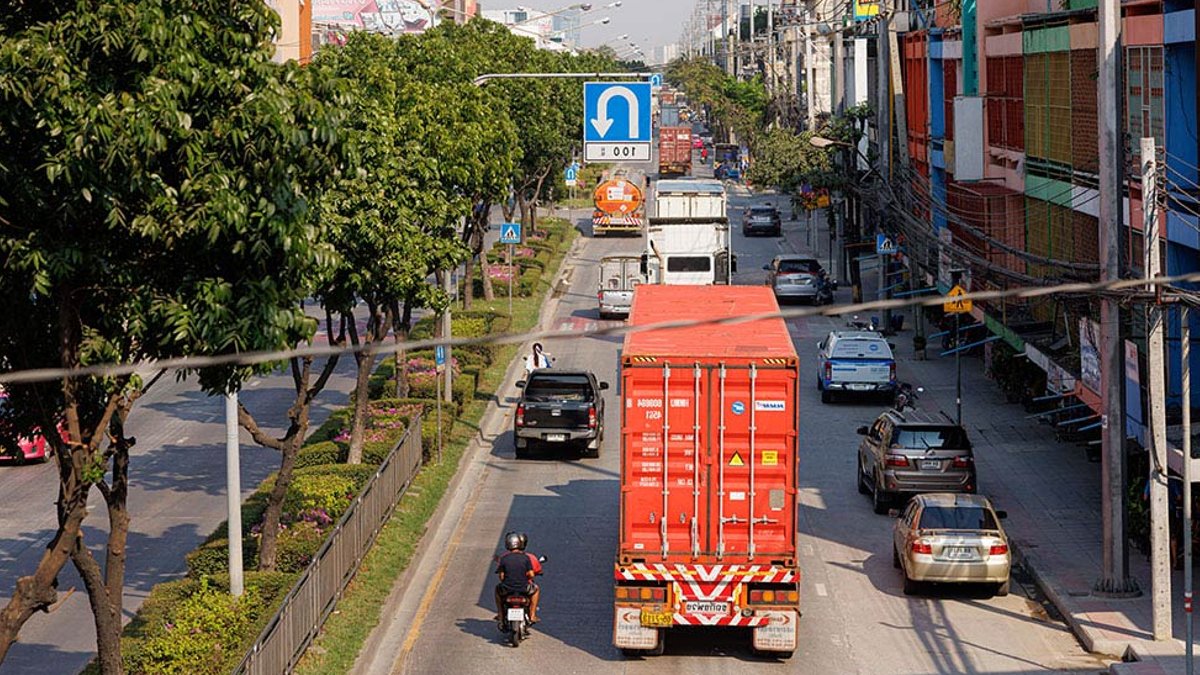
Trucks carrying shipping containers drive through Bang Na district in Bangkok, Thailand, Monday, January 29, 2024. — reporters
Thailand, the Philippines and Argentina are among a group of promising yet underutilized economies primed for an increasing role in supply chains, according to a new analysis of global trade trends.
These and other countries in Southeast Asia and Latin America stand to benefit from diversification as companies look beyond cost and efficiency to build resilience, Verisk Maplecroft, a UK-based risk intelligence firm, said in a report released Thursday.
A third of the world’s busiest ports and airports are vulnerable to disruption from conflicts, environmental risk and domestic security threats, the firm warned. At a time when trade resilience has deteriorated in more than 150 countries — accounting for 90% of global trade — there’s opportunity for “rising stars,” the analysis argued.
The shuttering of the Strait of Hormuz during the US-Israel conflict with Iran created “near-term headwinds” for both Thailand and the Philippines, Verisk Maplecroft said. The firm’s data indicate that those “willing to take a longer-term view will find these markets worth their attention.”
Market openness, regulatory strengths and labor rights in each country are the three main factors the firm analyzes.
Related: Types of Door Lock You Need To Know!
Political turmoil hasn’t stopped the Philippines
The supply chain potential in the Philippines comes despite a bout of political turmoil in the past year, including a sprawling scandal over corruption in contracts for flood mitigation projects that’s seen politicians issued with arrest warrants.
That graft scandal dented foreign investment in the Philippines last year, and has been a factor in the government cutting its economic growth forecast for this year. The Senate, meantime, has been consumed by infighting related to a rift between President Ferdinand Marcos Jr. and his deputy, Sara Duterte, who faces an impeachment trial in July.
“Things are still happening behind the scenes, including efforts to attract investment and reduce regulatory burdens on businesses — though the results of these efforts have yet to fully emerge,” according to Laura Schwartz, senior Asia analyst at Verisk Maplecroft.
Sometimes political chaos completely stops policymaking.
And sometimes it happens alongside policymaking.
With a young, English-speaking labor force, the Philippines offers significant potential for industrial services and outsourcing, she said. “If you are confident in your company’s supply chain management systems to monitor and manage corruption risk, that doesn’t have to be a complete barrier,” Schwartz said.
Related: The Value B2B Marketing Agencies Bring to Modern Businesses
Thailand’s electronics sector gets an AI boost
Risks for Thailand have decreased when compared with regional peers during the past five years, the firm said. Thailand’s electronics sector is benefiting from AI investment, and the country is “well positioned to host higher-value supply chain links,” according to the firm. That’s even with an aging workforce and higher-cost labor versus others in the region, it said.
“The ingredients are really good for a lot of the industries that are seeking supply chain diversification opportunities,” Schwartz said.
For Argentina, both the European Union-Mercosur trade accord and an agreement with the US on reciprocal trade and investment could drive a shift on critical minerals, energy and industrial exports.
Chile and Uruguay are also on the regional list, with the latter offering the region’s strongest risk-adjusted operating profile.
“Latin America still trails Southeast Asia as a scaled manufacturing platform, but Western efforts to reduce exposure to China are creating new supply-chain contenders,” the report said.
The analysis also points to Vietnam, Malaysia, Mexico and Brazil as already benefiting from the reduction in bilateral trade between the US and China. Those four have their advantages as supply hubs, the report said, “but according to our data, risks to multinational supply chains in all of these jurisdictions are increasing.”