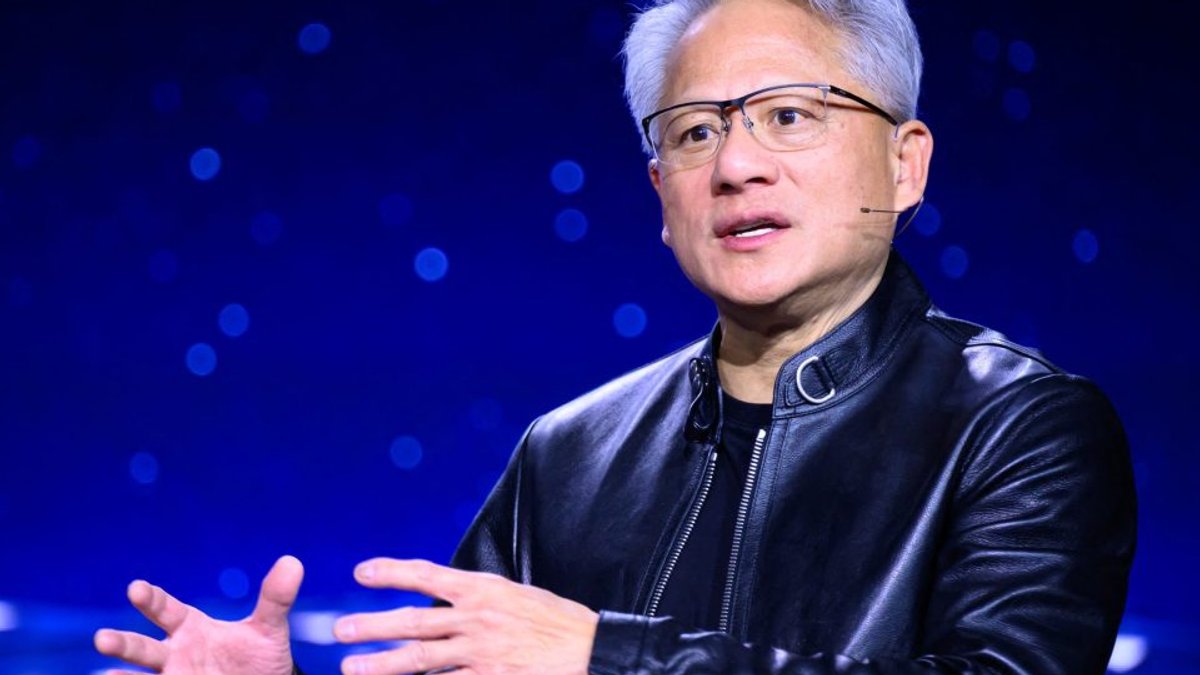
Nvidia offered investors a rare look at its future on Wednesday, projecting revenue growth of 70% for the next fiscal year. The forecast sent its stock up more than 4% in after-hours trading.
Demand for AI chips grows at 100%, but supply lags
The company’s preliminary outlook for fiscal 2028 revenue fell between $690 billion and $700 billion, exceeding analyst expectations by over $100 billion. CEO Jensen Huang described the coming year as “pretty extraordinary,” noting Nvidia had never before provided a full-year forecast.
“We wanted everyone to have the same information,” Huang said during a conference call. “We have a huge year ahead.”
Chief Financial Officer Colette Kress stated customer forecasts indicated Nvidia’s growth would accelerate in the next 12 months. Demand for its AI chips is increasing at 100% annually, fueled by hyperscale cloud providers and a growing segment of non-hyperscale customers. These include sovereign AI projects, AI startups, and enterprises, which now make up half of Nvidia’s business.
Supply constraints remain a challenge. Huang explained that the entire supply chain is strained, limiting the company’s ability to meet demand. “Even though our demand is much greater than 70%, our supply allows us to confidently deliver 70%,” he said.
Related: Solar panel recycling to reach 20 billion
Agentic AI drives compute demand
The demand surge reflects a change in how AI systems use computing power, particularly as autonomous software agents performing complex tasks become more common. Huang noted these agents require 15 to 100 times more compute than traditional workflows.
“We have roughly 40,000 employees,” he said. “In the future, we’ll have 400,000 agents, 4 million agents, and those agents run continuously.”
Nvidia’s recent quarterly performance highlighted its strong position. Revenue reached $96.2 billion, a 106% increase from the previous year, surpassing analyst expectations. Earnings per share came in at $2.22 on a non-GAAP basis, above forecasts. The company also projected next quarter’s revenue at $108 billion, matching the high end of estimates.
This growth has made Nvidia the world’s most valuable company, with a market capitalization exceeding $5 trillion. It has also attracted attention for its aggressive investments in the broader AI ecosystem, which some critics describe as circular financing.
Kress defended the approach, calling the investments low-risk. “We recognize the scale of this support, and we know some will call this circular financing,” the Nvidia finance chief said. “We see it differently.”
For smaller AI cloud providers, Nvidia guarantees payment for a minimum portion of a data center’s capacity, satisfying lenders while taking a share of rental revenue above that threshold. “Independent capital still evaluates every deal on its own merits,” Kress said. “We’re not providing loans.”
Related: Iran vows defiance as sanctions tighten
Some analysts view the price increases as a risk. Nvidia has raised prices by about 15% to offset rising memory costs. Bill Birmingham of Rex Financial warned that increasing prices when the return on investment for AI remains uncertain could backfire.
Kress acknowledged the margin pressure, stating gross margins would dip to 71% to 72% in the fourth quarter before stabilizing around 72% to 73% next fiscal year. Supply and capacity commitments rose from $119 billion to $279 billion, partly due to higher memory costs affecting the entire tech sector.
Huang said Nvidia had prepared for the memory price crunch by securing long-term agreements with suppliers. “A long time ago, people asked why we were working with memory suppliers when we’re a chip company,” he said. “Today, people see the value in our upstream supply chain strategy.”
The challenge now is whether Nvidia’s growth can outweigh the risks. The market appears willing to take that bet.
As AI adoption expands, concerns about patient access to new treatments have also surfaced, though the company’s focus remains on meeting demand for its hardware.





Leave a Reply